
What Morris County Property Tax Records Show
Three offices split the work. The Morris County Appraiser keeps parcel identity, ownership, classification, and the land and building values. Those figures feed the assessed value used as the tax base. The Clerk builds the rolls and abstracts, sets out mill levies, and maintains special-assessment, abatement, addition, and escape records. The Treasurer bills and collects the tax, posts each payment, and distributes the money. Read all three together. A valuation field is not a bill. A bill, in turn, is not proof of payment. Cross-checking Morris County property tax records across offices prevents that mix-up.
| Field | What It Shows | Where |
|---|---|---|
| Appraised value | The Appraiser's estimate before the class assessment rate is applied | Appraiser parcel record |
| Assessed value | The tax base produced under Kansas classification rules | Appraiser and tax roll |
| Property class | Residential, agricultural use, commercial, exempt, or another portal class | Appraiser parcel record |
| Tax and payment status | Current bill, history, installments, and posted payments | Treasurer tax portal |
| Levies and special assessments | Taxing-unit rates and parcel charges maintained for the roll | County Clerk and Treasurer |
An appraised figure is not a sale price. Neither is the assessed figure the amount due. Kansas applies a class rate to appraised value to produce assessed value, while agricultural land is valued by its use rather than by the market. Levies and special assessments shape the bill. The public portal also leaves out sales information, so its value fields are no substitute for a market history.
Morris County Appraiser Search Fields for Tax Research
Start with the free Morris County Real Estate Portal, which supplies the parcel identity behind any tax question. It requires no account. Sales information, though, stays out of public view there. Search with the least ambiguous key available, then carry the returned parcel number and Quick Reference number into the tax search.
| Portal field | Useful tax task | Search note |
|---|---|---|
| Owner name | Find parcels billed under a known owner | Any part of the name may be used |
| Full Address | Identify the parcel before opening its tax history | Street components may also be entered separately |
| Property # | Match the tax account to the county parcel | A starting portion or full identifier is accepted |
| Quick Reference # | Cross-check a result returned by the county system | Use the county-issued reference exactly |
| Tax Unit / Section | Narrow by the unit tied to a levy | The portal provides a coded selector |
| Value range and class | Review comparable assessed records | Class must be kept with every value comparison |
A blank address result proves nothing. The address may simply be recorded in another form. Rural tracts often answer better to an owner name, a property number, or the section-township-range fields. A written request to the Appraiser can confirm whether a parcel card or map record exists.
A Morris County Parcel Card in Context
Searching 501 W Main returns one parcel card. The parcel number is 064-126-14-0-30-07-001.00-0, and the Quick Reference is R4309. The card lists Morris County as owner, Council Grove Original Block 46 Lot ALL as the tract, 2.2 acres, and the class Exempt-E. Land, building, and total values each appear separately.
That card shows why class and legal description matter. They belong beside any number copied from Morris County property tax records. It also shows the limits of public access. The public record carries no sale field or mailing address. For the bill and payment status, use the Treasurer record rather than the parcel-card total. The official sample result shows the county's field layout and the Current Values route.
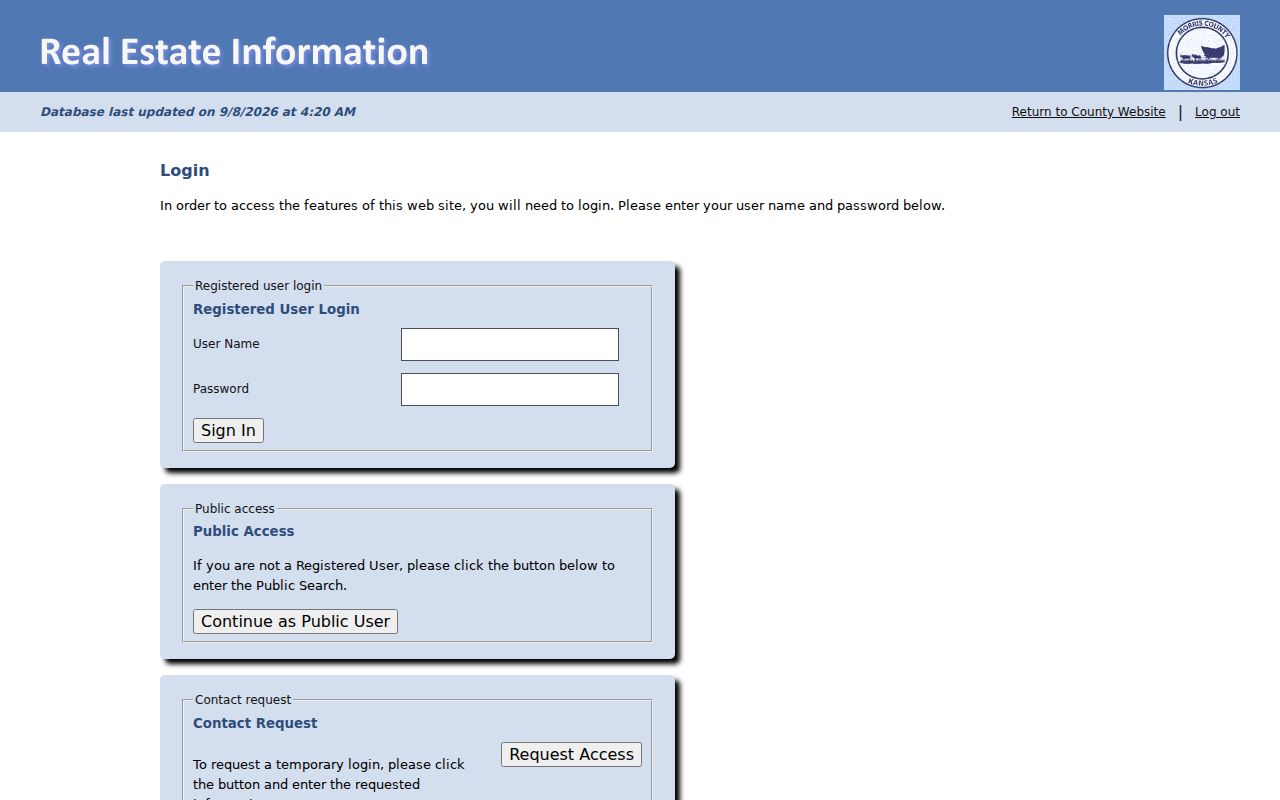
Treat the image as a field guide only. The live record remains the authority for any current tax-year review in Morris County.
Morris County Statements, Installments, and Payment Limits
Statements go out in mid-November, usually November 6 through 14. First-half tax is due December 20. The second half falls due May 10. No second-half statement goes out. So the original statement and a calendar matter to any Morris County property tax file. The county's online route covers current tax and tax history. Online payment is narrower. It accepts only current tax, in the exact original billed amount. It also requires a statement number. Delinquent amounts must go through the office instead. Contact the Treasurer for the official payoff balance. Interest is included, so do not infer it from an old statement.
How to Look Up a Morris County Tax Bill
Fix the parcel identity first. Addresses, owner names, and legal descriptions change, and the same parcel can be entered in several forms. The Treasurer tax endpoint is official. Even so, the county publishes no complete field specification or historical coverage start date. Note the tax year and identifiers used.
- Find the parcel in the Appraiser portal by address, owner, parcel number, subdivision, or rural legal description.
- Copy the full parcel number and Quick Reference number, then open the Morris tax search.
- Read the statement year, billed amount, installment status, payment history, and special-assessment lines that the result provides.
- Compare the class and values to the Appraiser record, then ask the Treasurer for any delinquent balance not payable online.
- Assessed value
- The class-adjusted tax base, distinct from both the appraised figure and the final bill.
- Mill levy
- A rate applied to assessed value for the taxing units serving the parcel.
- Homestead program
- A Kansas rebate program with its own eligibility and filing rules, not a generic parcel-class label.
- Tax lien
- A public claim arising from unpaid tax; title impact should be confirmed in the relevant official files.
Who Maintains Morris County Tax Roll Details
Send each question to the office that keeps the record. The Appraiser, at 501 W Main Street in Council Grove, (620) 767-5533, handles parcel value and ownership fields. The Clerk, Suite 9, (620) 767-5518, covers rolls, abstracts, mill levies, taxing-unit material, special assessments, abatements, additions, and escapes. The Treasurer handles billing, collection, distribution, and delinquency. This division matters when records disagree. A deed change may need to flow through the Appraiser system. A missing payment belongs with the Treasurer. Ask for the existing record. Name the parcel, tax year, and format.
Morris County Levies Are Not Parcel Bills
The Clerk publishes tax-levy documents covering 2019 through 2025. The county taxing-unit map is dated January 25, 2021. Those materials show which local units and boundary lines can touch a given parcel. They do not show what one owner was billed for one year. A levy sheet spreads the burden across the whole county. It never functions as a parcel bill.
Treat the levy document as background. Then work from the parcel's assessed value, its tax unit, and the Treasurer statement. Suspect a special assessment, abatement, addition, or escape? Request that specific Clerk record rather than trusting a countywide sheet to capture it. The distinction matters most where a postal address and a city-limit line disagree.
Delinquent Morris County Property Tax Records
Late tax accrues interest. If real estate tax remains unpaid after May 10, the full amount plus interest comes due. Three years of delinquency can make a property eligible for county tax foreclosure and public auction after due process. Eligibility is not foreclosure. The county publishes no live delinquent roster online.
For one tract, ask the Treasurer for existing delinquency, interest, notice, and payment records. Ask the Clerk which foreclosure or auction files it holds. Recorded instruments and liens belong to the Register of Deeds. Do not assume the three-year condition has been met. Ask the county to identify the parcel's current status instead.
Appealing a Morris County Assessment
An appeal starts with the written valuation notice, not the tax bill that arrives later. Kansas guidance gives owners 30 days from that notice. Owners can then contact the county appraiser for an informal meeting. Save the notice. Note the date it arrived. At the meeting, bring parcel facts, evidence of the property's condition, and comparisons matched correctly. Keep the portal class attached to every value cited.
Appeal window. Contact the Morris County Appraiser within 30 days of the written valuation notice and check the current Kansas property-tax calendar for that tax year.
At the informal meeting the county presents its evidence. The taxpayer may respond, and written results follow. Kansas guidance also describes later routes. These include Payment Under Protest and a Board of Tax Appeals small-claims path for qualifying property. Deadlines and route rules shift with the tax year and the case. Rely on the current state guide rather than treating a past calendar as permanent.
Escrow and Morris County Tax Notices
A mortgage company may receive the tax statement. Past-due notices still go to the homeowner, the county says. A taxpayer whose lender pays through escrow should forward the statement when needed, then confirm the payment shows up in the Treasurer record.
The mailed notice, the lender's disbursement, and the county-posted payment are three separate pieces of evidence. Keep all three together. That habit makes a missed installment or an account-number mismatch far easier to resolve, without mistaking a deed or parcel card for proof of payment.
Requesting Missing Morris County Tax Records
When the online view falls short, state exactly what you want. Ask for the current statement, account or statement number, tax year, billed amount, first-half and second-half status, special assessments, payment history, and current delinquency or interest status. Add the full parcel number. Include the legal description if you have it.
The County Clerk's open-records form provides requester contact and signature fields. It includes four lines for record titles and dates, a copies-requested section, and a custodian section. It covers records filed or available in the Clerk's office. It is not a universal tax or deed form. Under the Kansas Open Records Act, inspection is generally available during regular hours. The custodian must respond as soon as possible, and no later than the end of the third business day, or explain any delay. Reproduction, staff, and redaction-review costs may apply. Advance payment or a written request can be required.