
Recognize Morris County Deed Records by Instrument Type
The Morris County Register of Deeds logs the county's land instruments. A deed conveys an interest. Mortgages, liens, leases, easements, plats, and releases do different work, burdening, describing, or clearing that interest without carrying the transfer itself.
| Deed or instrument | What it generally does | Why to inspect it |
|---|---|---|
| Warranty deed | Conveys the stated interest with deed covenants | Common link in an ordinary purchase chain |
| Quitclaim deed | Conveys whatever interest the grantor has without the same warranties | May resolve family, divorce, or title-cleanup changes |
| Trustee, executor, sheriff, or fiduciary deed | Conveys through a trust, estate, court, or authorized sale | Signals a related trust, probate, foreclosure, or court file |
| Tax deed | Documents a conveyance associated with tax-sale proceedings | Requires checking delinquency, notice, redemption, and court records |
| Affidavit or corrective instrument | Adds facts or corrects a recorded description | May explain a name, legal-description, or vesting discrepancy |
Read each deed with its prior instruments. A deed names the parties and the legal description. Yet a mortgage release, mineral reservation, easement, probate order, or plat may sit elsewhere in the recorded file, telling the rest of the story.
What the Morris County Register Actually Records
The official inventory runs wide. The Morris County Register of Deeds holds deeds, affidavits of equitable interest, mortgages, assignments and releases, oil and gas leases, powers of attorney, surveys, plats, federal and state tax liens, lis pendens, military discharges, and UCC fixture filings. Kansas law closes only the Real Estate Validation Questionnaires and military discharges. Everything else remains open.
That breadth matters in a deed search. A transfer can point to a controlling plat. A survey may hold a boundary clue, assignments and releases explain a mortgage, and a lis pendens flags pending litigation. Rural parcels need extra care. Search oil, gas, mineral, easement, and right-of-way terms rather than assuming the surface deed tells the whole story.
The RMIS Gate on Morris County Deed Searches
Morris County gates its deed index behind the RMIS login. Users enter a username and password. A six-digit CAPTCHA guards entry, with an audio option available. Public subscribers are directed to an eSearch route. The Register maintains the records, and the interface states the index is not guaranteed accurate. Kansas Open Records Act restrictions, including K.S.A. 45-230, apply.
None of this promises online deed images. A name search may not reach a particular year. Treat RMIS as one tool, and call or visit Suite 10 at the courthouse when the gate blocks a complete search.
The official RMIS screen shows why office access remains part of the deed-record workflow:
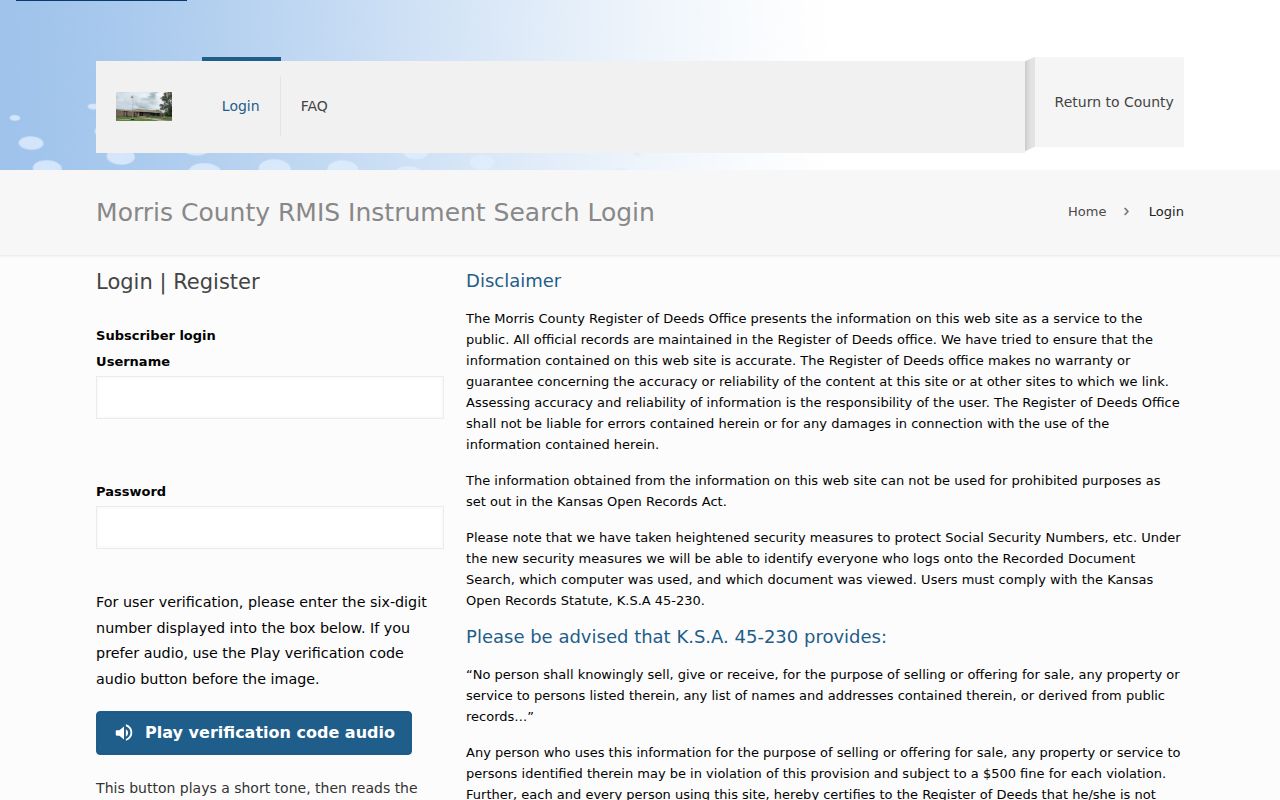
The screen documents access conditions, not that any particular instrument is indexed or viewable online.
Follow Morris County Grantors and Grantees in Order
Start with the current owner. The Morris County property search shows that owner, and the deed confirms the transfer, so keep the legal description constant while the party names change.
- Find the present owner's acquisition deed, where that owner appears as grantee.
- Read the grantor, deed date, recording date, instrument type, and book/page or instrument reference.
- Search the grantor as a grantee to find how that person previously acquired the same land.
- Repeat, checking description changes, corrective filings, estate instruments, and referenced plats at each step.
- When the electronic trail ends, continue with the corresponding deed book or historical index rather than assuming the chain begins there.
- Grantor
- The party who conveyed the stated interest.
- Grantee
- The party who received it.
- Chain of title
- The ordered sequence of instruments affecting ownership of the same land.
- Book/page or instrument number
- The recording reference used to retrieve the filed document.
Morris County Recording Rules Affect What Gets Indexed
The county's current recording requirements demand original signatures from signer and notary, notarization, a Morris County legal description, and the proper filing fee. Photocopies are refused. A certified copy needs the original certificate. The first-page top margin is three inches, the minimum font is eight point, and Kansas law governs legibility.
Deeds and affidavits of equitable interest also require the Kansas Real Estate Validation Questionnaire or a typed exemption number. The listed exemptions cover plenty. They include qualifying gifts, cemetery lots, certain trust or divorce transfers, joint-tenancy changes, sheriff deeds, and quitclaims that clear an encumbrance. The questionnaire itself stays closed. The deed and its exemption form the public trail.
Current Fees for Morris County Land Instruments
| Record service | Published fee | Research note |
|---|---|---|
| Deed, mortgage, or other instrument | $21 first page; $17 each additional page or fraction | Confirm before filing or ordering |
| Mortgage assignment or release | $20 first page; $4 each additional page or fraction | Separate schedule |
| Town plat | $32 per page | Applies to recording |
| Certificate certifying an instrument | $13 | Add when a certified record is required |
| Materials/services lien; lis pendens | $17; $5 | Different instrument categories |
| Federal tax lien notice or release | $32 each | Search notice and release separately |
A single-family principal-residence mortgage of $75,000 or less carries a $125 fee cap when the county's affidavit conditions apply. Typed names beneath signatures can add $1. Fees can change. The Register should confirm the total for the exact service and page count.
Continue Morris County Deeds Into the Archival Era
Morris County deed research reaches back before statehood. The Kansas Historical Society catalog lists deed records, a General Index to Deeds, and patent and homestead papers. The catalog also lists land-office files, tax deeds, and numerical city-lot and county-property indexes. Some of that territory predates the county itself, since Morris County was organized in 1859. The numerical indexes alone run from 1857 to 1999. Cataloged does not mean downloadable, though, so plan on a reference request for most items.
Two stretches deserve special attention. Between 1859 and 1903, the General Index to Deeds works as a grantor/grantee bridge. From 1858 to 1862, Western Land District records may step in ahead of the county deed chain. Patent or homestead material may do the same. One caution on place names: search the spelling written in the historical instrument. Older documents may name towns, townships, post offices, or additions. Some of those places have since changed or vanished.
The archival collection results display the range of Morris County deed records and indexes. You can request them from the society.
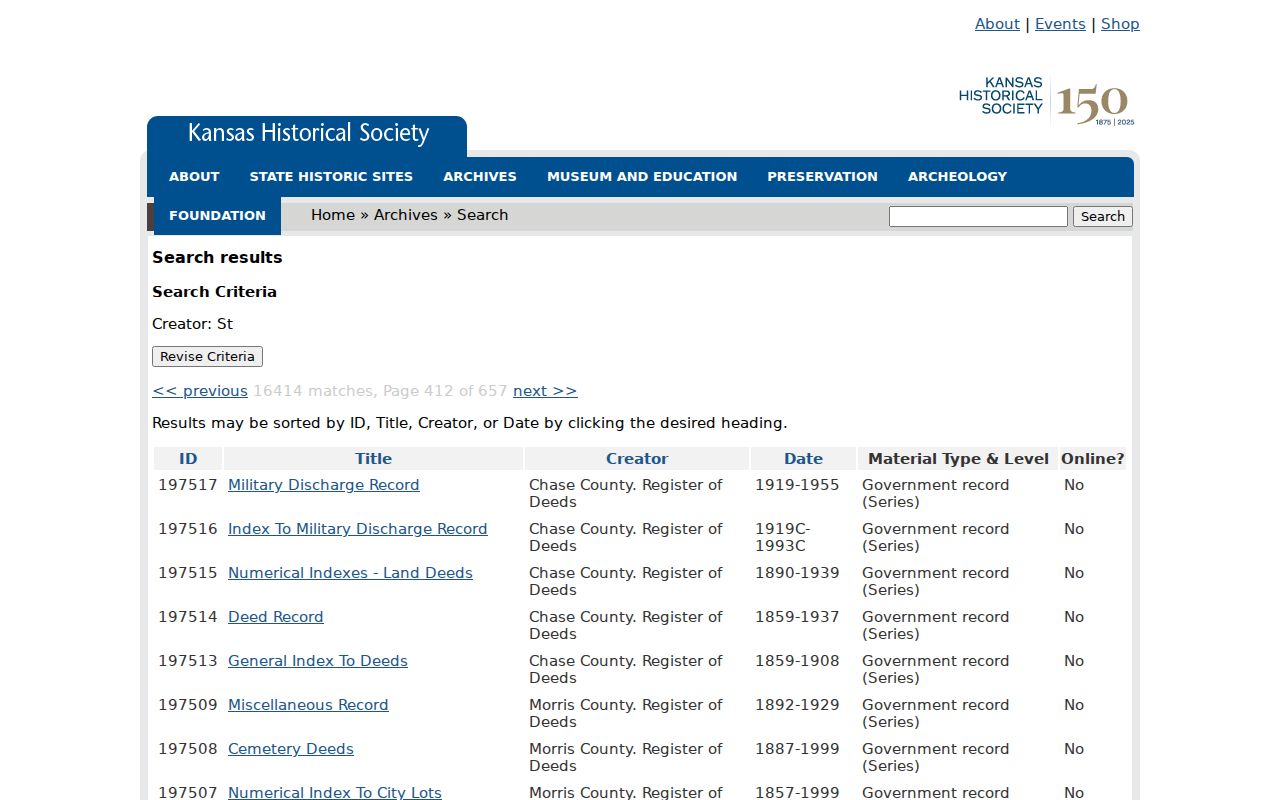
Gather the collection title, date span, volume or series, and legal description before contacting the archives.
Request an Official Morris County Deed Copy
Ask the Register for an existing index entry and copy using the grantor, grantee, present or prior owner, full legal description, subdivision/block/lot or section/township/range, instrument type, and a date range. Include the parcel number as a cross-reference, not the only key. State whether an ordinary copy is sufficient or certification is needed, and request a cost estimate.
The office is at 501 W Main Street, Suite 10, Council Grove, KS 66846; telephone (620) 767-5614 and fax (620) 767-6712. In-person, phone-assisted, and written requests are therefore important alternatives to the gated index. A broad Kansas Open Records Act request may incur reproduction, staff, and redaction-review costs; a precise instrument reference usually makes retrieval more efficient.
For a chain request, identify the categories to be checked: deeds, affidavits, corrective or quitclaim instruments, mortgages, assignments and releases, easements, plats, surveys, liens, lis pendens, oil and gas leases, mineral-interest instruments, and referenced prior filings. This keeps transfers separate from encumbrances while still exposing documents that may explain the chain. Request certification only where it is genuinely needed because certification is a separate paid service.
Recorded, not guaranteed. Morris County deed records show instruments accepted for recording. They are not a title opinion, and unrecorded interests, incomplete releases, or outside proceedings may still matter.
Cross-Check Morris County Deeds With Related Instruments
Stop the deed-chain search whenever something shifts. A changed legal description, party name, or conveyed interest all warrant a pause. Then check the Register's related categories. These include affidavits, corrective instruments, powers of attorney, surveys, plats, mortgages, assignments, releases, tax liens, lis pendens, oil and gas leases, and UCC fixture filings. A mortgage does not convey what a deed conveys. An assignment is not a release either. Record each document type and its reference separately. That way an encumbrance never gets mistaken for a transfer of ownership.
Court events sometimes explain an odd transfer. The Eighth Judicial District record search sends Morris County matters to Kansas CaseSearch. There a party name, case number, case type, or filing-date range can reveal a foreclosure, probate, partition, quiet-title, or lien clue. CaseSearch is not the official court file, though. Ask the District Court clerk for the underlying order or docket. From there, determine whether the deed, sheriff's instrument, lis pendens, or release actually reached the recorder.
Distressed property needs extra care. Tax-sale or foreclosure eligibility is not a completed transfer on its own. The Treasurer lays out delinquency and possible foreclosure after due process. Historical KHS tax-deed series offer archival leads. Confirm the notice, any redemption, the court disposition, and the final recorded instrument. This source-by-source check matters most for deeds signed by fiduciaries, trustees, executors, or public officials.