
Sources That Reveal Morris County Former Owners
No database covers every era of Morris County ownership. Start with the newest solid identity, then work from current county records back into the Kansas Historical Society catalog once the modern route stops.
| Source | Documented period | Where held | What it contributes |
|---|---|---|---|
| Current deed index and instruments | Coverage start not verified online | Morris County Register of Deeds / gated RMIS route | Grantor, grantee, instrument, legal description, references |
| General Index to Deeds and early deed records | Approximately 1859-1903 | Kansas Historical Society catalog/reference access | Early grantor-grantee links, instrument type, date, page |
| Numerical city-lot and county-property indexes | 1857-1999 | Kansas Historical Society | Bridge between old lot/property numbers and deed references |
| Western Land District, patent, and homestead records | Especially 1858-1862 | Kansas Historical Society and land-office collections | Possible first federal or territorial-era ownership clues |
| Tax-sale and tax-deed series | 1873-1916 documented | Kansas Historical Society catalog | Distressed-title leads that require deed and legal confirmation |
A catalog date only hints when a collection helps. It proves neither online pages nor full survival. Before requesting access, record the series, volume, date span, and land description.
Walk a Morris County Deed Chain Backward
Work one owner at a time. Treat each prior owner as a grantee in some older acquisition, keeping the parcel's legal identity fixed while names and instrument numbers change.
- Use the current-owner record to capture the owner, parcel number, Quick Reference, situs, and legal description.
- Find the newest acquisition deed, with the current owner as grantee.
- Read the grantor, deed type, recording date, and book/page or instrument reference.
- Search that grantor as a grantee to locate the earlier acquisition of the same property.
- Repeat until the electronic record ends, then use the cited volume or numerical property index in the archival collection.
- Grantor / grantee
- The person or entity that conveyed / received the stated interest.
- Chain of title
- The ordered sequence of recorded instruments affecting the same property.
- Reverse index
- A name-based route organized from the opposite party perspective, useful when tracing backward.
- Legal description
- The lot/block, subdivision, or section/township/range language that survives address changes.
- Quitclaim / warranty deed
- Different forms of conveyance; neither label alone proves the entire chain is clear.
Build a Prior-Owner Timeline Without Guessing
| Transfer date | Grantor → grantee | Deed type | Reference and land match |
|---|---|---|---|
| Newest recorded transfer | Previous owner → current grantee | Copy exact instrument label | Book/page or instrument number; compare full legal description |
| Prior acquisition | Earlier grantor → previous owner | Copy exact instrument label | Note any changed lot, acreage, or referenced plat |
| Earlier deed-book link | Earlier parties as indexed | Deed, corrective, fiduciary, or other transfer | Volume/page and archive series |
Copy names exactly. Keep initials, entity suffixes, and spelling variants intact. Record both execution and recording dates when supplied, and expect a chain to look broken whenever an estate, trust, court order, sheriff deed, name change, or corrective instrument sits between two ordinary deeds.
Why the Morris County Online Cutoff Stays Unknown
The Morris County RMIS interface sits behind a login screen that links to a public subscription route. A username and password are required. No confirmed start date exists for the digitized deed records behind that gate. The earliest online year stays unknown. Stating that gap plainly beats inventing a digitization date. The Register of Deeds can identify the correct current and older access channel at 501 W Main Street, Suite 10, Council Grove, KS 66846, telephone (620) 767-5614. Bring party names, a date range, deed type, subdivision/block/lot or rural description, and any known recording reference. The official login page displays the requirement:
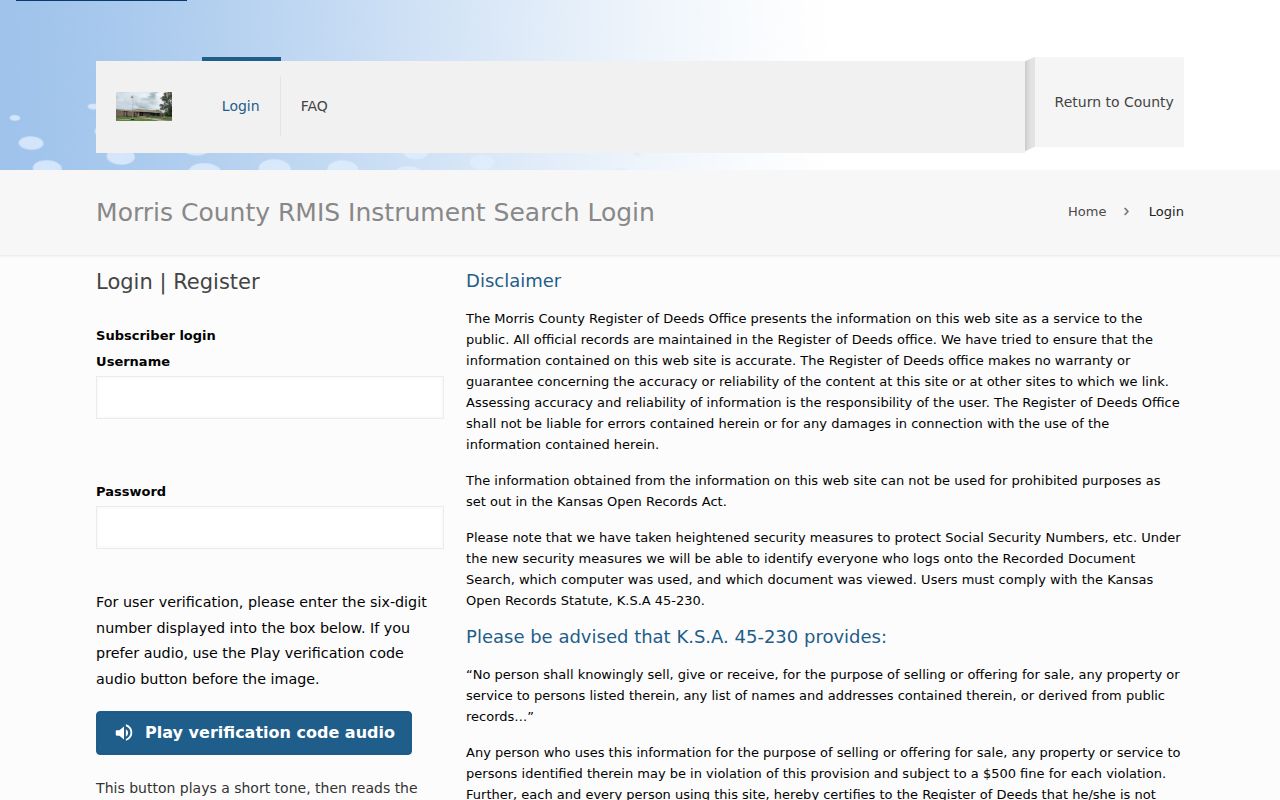
The login gate is real. It says nothing about the age or completeness of the Morris County records behind it.
No verified online start year. When the digital trail stops, ask the Register or Kansas Historical Society for the cited deed book or index instead of treating the first online hit as the first owner.
Morris County Ownership Before the Modern Index
Morris County was organized on February 11, 1859. Before that came a territorial Wise County period. Government names can shift while the land stays put. Research from 1858 through 1862 may require Western Land District files plus patent or homestead records. The General Index to Deeds supports much of the 1859-1903 span. The KHS Register of Deeds catalog results list deed, patent, homestead, tax-deed, land-office, city-lot, and county-property material:
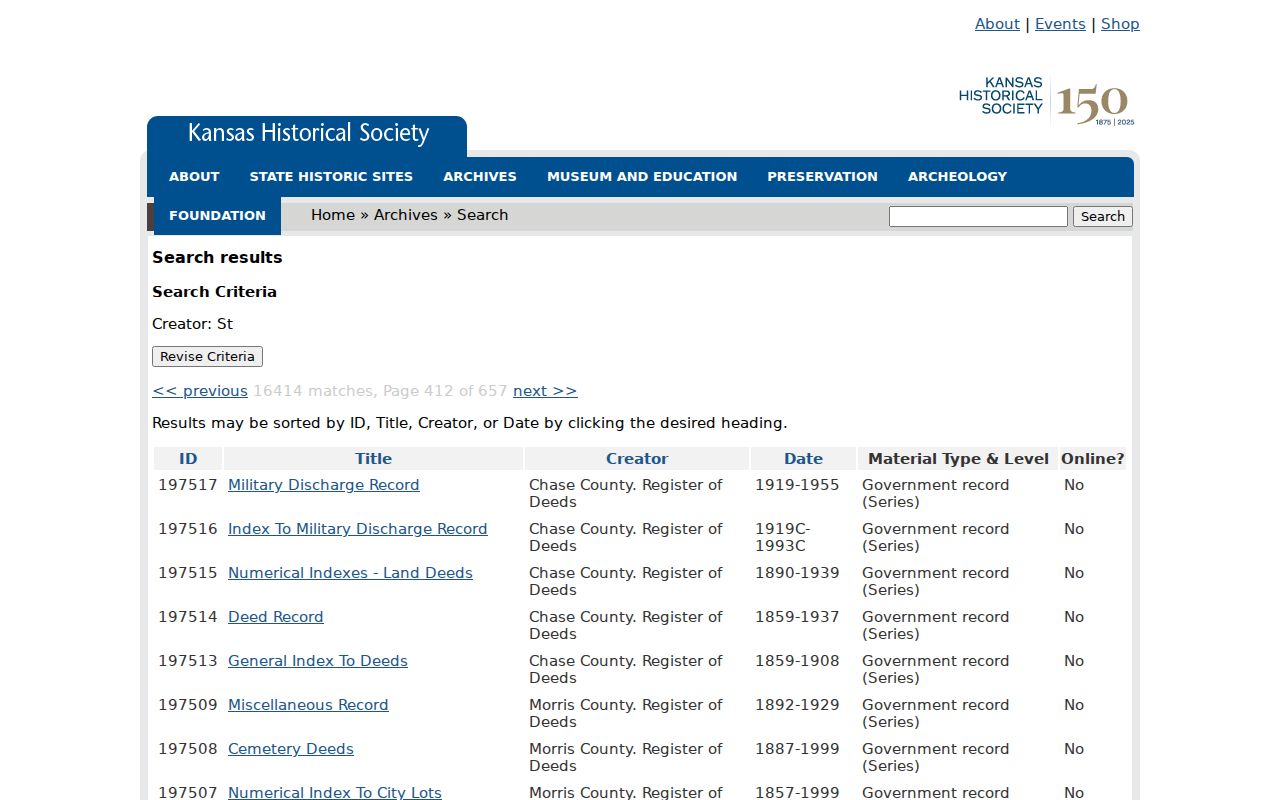
A finding aid is not the record itself. Researchers still need the underlying page, matched carefully to the present parcel.
Use Historic Morris County Place Names as Clues
Older Morris County instruments may name Council Grove, Dunlap, Dwight, Latimer, Parkerville, White City, Wilsey, Burdick, Delavan, Skiddy, a township, a post office, or a named addition. Today's city list misleads. Nineteenth-century geography was far wider than the current incorporated places. Search the text exactly as written. Only then test a modern equivalent. Platted land needs a second step. Compare the old lot and block against the Appraiser's subdivision choices. The portal includes COUNCIL GROVE ORIGINAL with numerous /CG additions, WHITE CITY ORIGINAL with several /WC additions, DWIGHT ORIGINAL, and other originals or additions across the county. Rural land is different. Preserve the section, township, range, acreage, and any metes-and-bounds call.
Note: A modern street or ZIP can point to the area, but the legal description is the stronger link across ownership eras.
Estate and Tax Records That Interrupt a Clean Chain
Estates and court processes can pull a former owner out of the plain grantor-grantee flow. When a fiduciary, foreclosure, or tax matter intervened, the transfer left different marks. Look for trustee, executor, sheriff, and tax instruments in the Register's indexes. Corrective and affidavit instruments belong there too. So do lis pendens filings. The Eighth Judicial District record route can then surface probate, foreclosure, partition, or quiet-title case clues tied to the property. CaseSearch never substitutes for the official court file itself.
Tax-sale and tax-deed archival series offer leads covering the late nineteenth century through the mid twentieth. The runs span the eighteen seventies to the mid nineteen tens. A listing alone proves little. The sale may never have been finalized, or the owner may have redeemed in time. Confirm any result against the recorded instrument. Where the stakes are real, bring in qualified legal or title help.
How Far Morris County Prior Ownership Can Reach
A well-supported chain can reach back to county organization. Some tracts go further, into territorial land-office or federal patent material. The endpoint depends on the property's origin, surviving indexes, description changes, and whether the relevant collection was examined rather than merely cataloged. For archive requests, details matter. Provide the last known former owner, approximate date, municipality or township, subdivision/block/lot or section/township/range, deed type, and last book/page. Ask for the General Index to Deeds, the numerical city-lot or county-property index, and the cited deed-book page. The KHS Miscellaneous Record collection adds context. It holds historical grantor/grantee, land, and oil-and-gas material.
Lawful historical use. Prior-owner research supports house history, estate work, and property diligence. Never use a reconstructed chain to stalk, harass, or harm a living person.
Bridge Gaps Between Morris County Former Owners
Gaps in a Morris County chain of title usually reflect changing descriptions, not lost transfers. Pull each deed. Compare the acreage, lot and block, subdivision, and section, township, and range figures side by side. Check the plats each instrument references. A parcel split carries only part of an old tract into its new history. A consolidation welds separate ownership stories into one. When a modern street address fails, the numerical city-lot and county-property indexes shine. They tie older property identifiers to recorded pages, which keeps the chain intact.
Names need the same discipline. Hunt through the deed records using initials, prior surnames, spelling variants, trustees, estates, and entity forms exactly as the index spells them. Some chains pass through probate, foreclosure, partition, quiet title, or a tax proceeding. Treat the court file as a lead only. The recorded instrument, not the case docket, fixes the legally significant event. And a lone archival tax-deed or tax-sale entry in the property records cannot prove that redemption never happened.
Build a chronology as you go. List execution date, recording date, grantor, grantee, instrument type, reference, and the matched legal description for every deed. Flag each inference so it stays separate from documented facts. That worksheet lets you walk back into the Register of Deeds, KHS, or District Court with one narrow, dated question. You avoid a vague request for an entire property history.